Your Returns Process Is Costing You More Than You Think. Here Is the Math.
Ian Redlin, CEOJuly 15, 20265 minute read
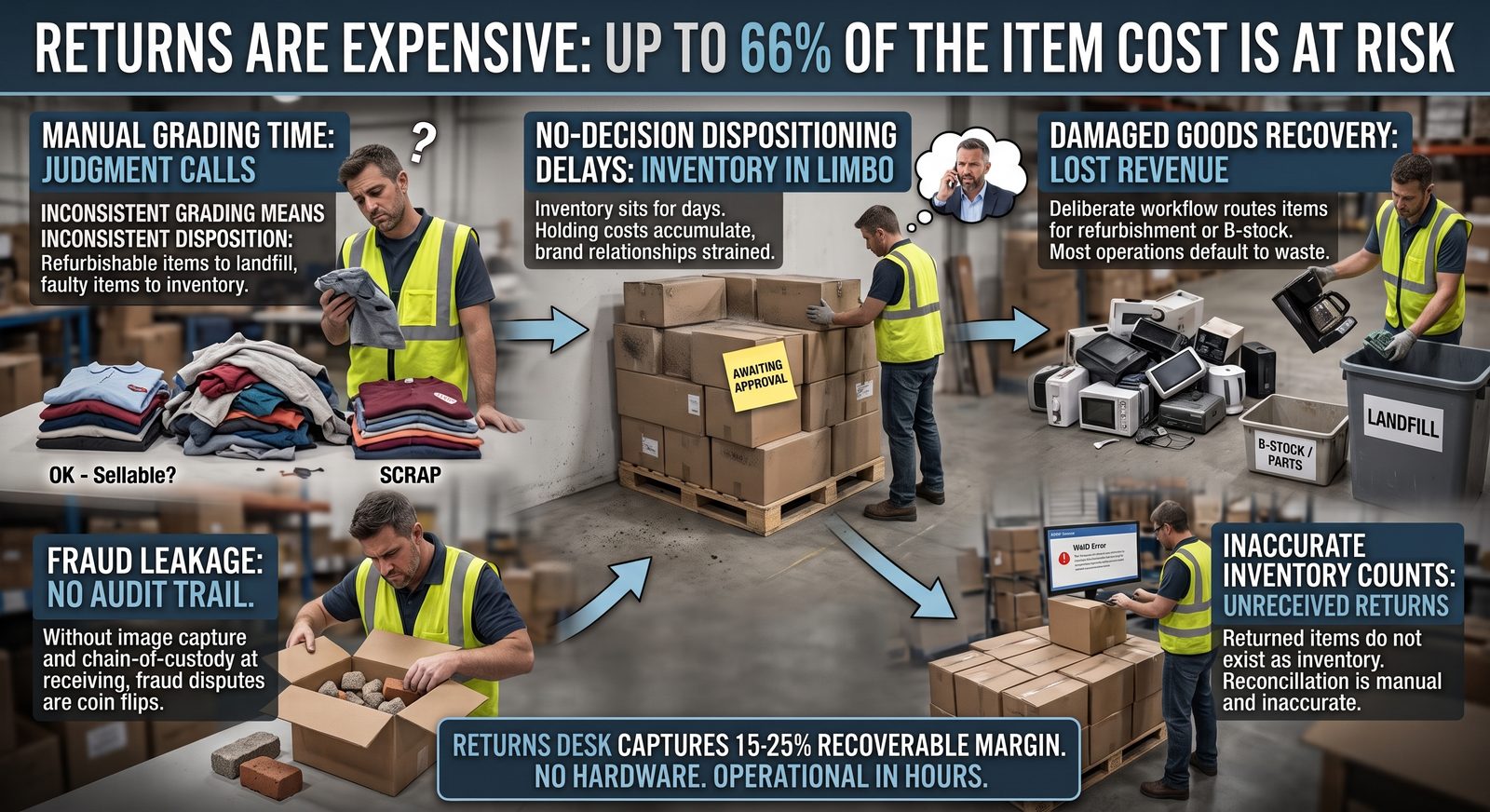
Processing a return can cost up to 66% of the item's original price. Most warehouse operators know returns are expensive. What they do not always know is exactly where the cost is accumulating, and how much of it is recoverable with the right process.
After 20 years in supply chain automation, the same five cost drivers show up in every manual returns operation. None of them require new infrastructure to fix.
Where the money goes
Manual grading time.
Without a guided workflow, each return is a judgment call made by whoever is standing at the dock. Inconsistent grading means inconsistent disposition. Items that could be refurbished end up in landfill. Items that should be quarantined for fraud end up back in sellable inventory. The labor cost is visible. The revenue leak is not.
No-decision dispositioning delays.
A return arrives, gets inspected, and then sits. Nobody has authority to act without approval. Inventory sits in limbo for days or weeks. The holding cost accumulates. The brand client gets frustrated. The 3PL relationship gets strained.
Damaged goods that should have been recovered.
Returns that arrive damaged are not necessarily unsellable. Many can be refurbished, recycled for parts, or sold as B-stock with appropriate grading. Without a disposition workflow that routes these items deliberately, they default to landfill. That is a recoverable cost that most operations never recover.
Fraud leakage without an audit trail.
Covered in detail in our fraud article, but the short version is this: without image capture and chain-of-custody documentation at the point of receiving, every fraud dispute is a coin flip. The documentation either exists or it does not.
Inaccurate inventory counts from unreceived returns.
Returns that are not properly receipted into the WMS do not exist as inventory. The brand does not see them. The 3PL cannot account for them. The reconciliation happens eventually, manually, and often inaccurately. The cost is hard to see precisely because it is hidden in inventory error rather than on a line item.
The math for a mid-size DTC brand
A brand doing $15M in revenue with a 17% return rate is processing roughly 2,500 to 3,000 returns per month depending on AOV. At $40 fully loaded cost per return, that is $100,000 to $120,000 in monthly processing cost. Annually, that is $1.2M to $1.4M.
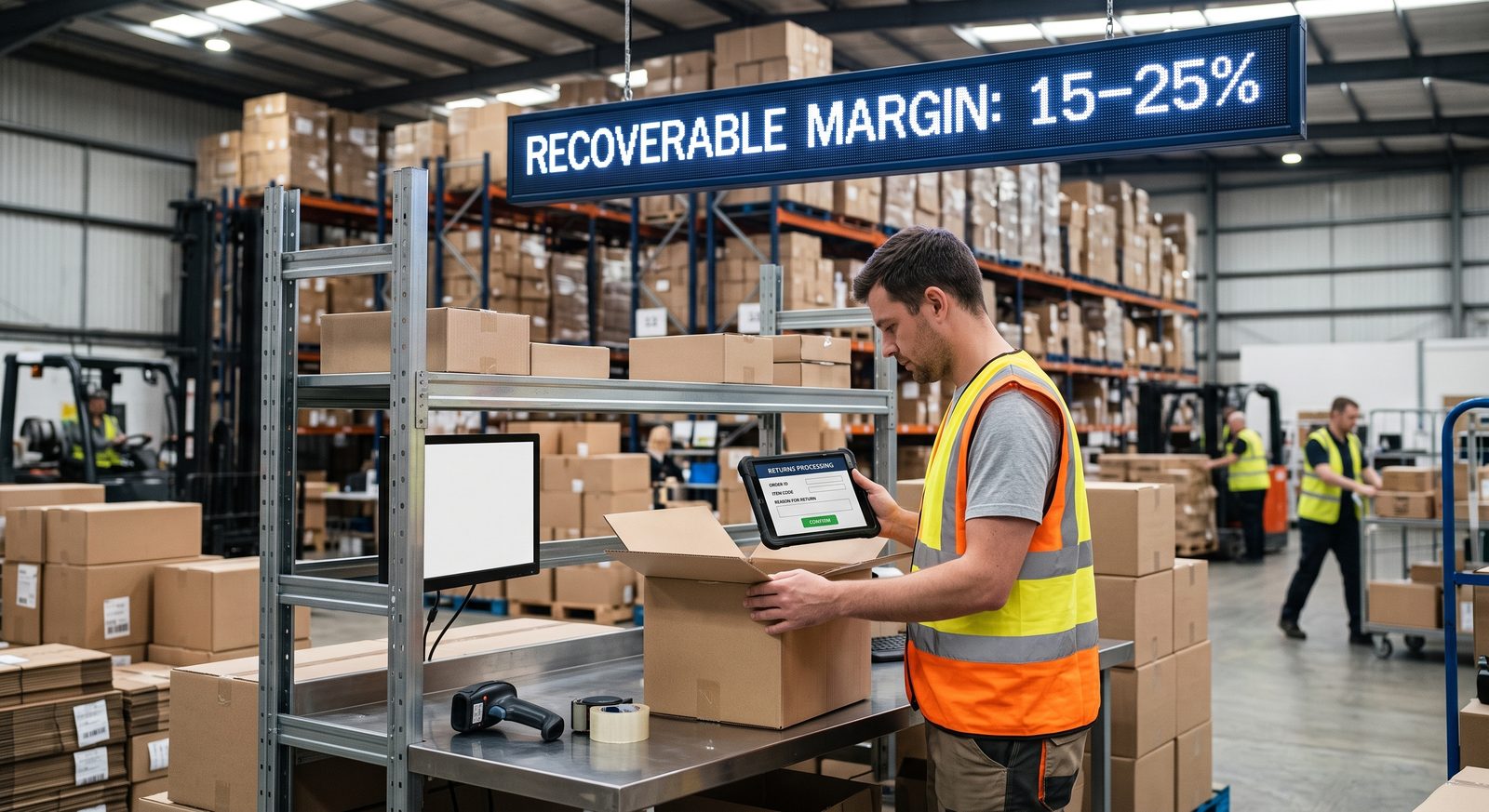
How much of that is recoverable? Conservative estimates in the industry put it at 15 to 25% through better disposition routing, fraud capture, and B-stock recovery. That is $180,000 to $350,000 annually for a brand at that scale.
Returns Desk is designed to capture exactly that margin. No hardware. No long implementation project. Operational in hours, not months.
If your operation recognizes any of this, that is the starting point for the conversation.
Start the conversation
Want the math run on your operation?
Tell us your volume and return rate. We will show you what is recoverable.